By Oleksii Popov · · Updated


Static hosting for vibe coders: one platform, many apps
Why I built this
While working on a dev platform, we once got a request that sounded simple on the surface: a super lightweight “vibe coding” space — friendly for non-technical people who wanted to sketch an idea quickly and see it live without learning deployment tooling.
There was no formal spec. The practical bar was roughly:
- make it easy for an AI agent to use end-to-end;
- when the agent finishes a change, hand back a demo link;
- let people iterate on that link until the idea is good enough.
That idea stuck with me, but this article is not about what we shipped at work. The team eventually took a different road — a heavier stack that kept picking up “one more technology” as requirements shifted late in the game. Fair enough for that context; it just was not the minimal static-hosting shape I had in mind.
This platform is a private experiment on my own time and AWS account: a way to satisfy builder curiosity and see how small the solution could stay while still feeling useful. Same spark, different constraints — optimize for cheap, boring, and agent-friendly instead of covering every platform feature on day one.
At its core it is still a hosting problem dressed as a product ask: you need a URL fast, you need previews while experimenting, and you do not want every experiment to become its own infrastructure project.
From one app to many
A few years earlier I had built static hosting with a protected dev environment — one app, multiple environments, and preview-style URLs on a dev subdomain. It was simple, cheap, and dynamic enough for feature work.
That design stuck in my head. The new question was:
What if we had the same preview-by-branch idea, but for any number of small static apps — not just one codebase?
That became this platform: still boring on purpose (S3 + CloudFront + GitHub Actions), but scaled out to many tenants with almost no ceremony per app. The older article’s conclusion already listed “dynamic subdomains” and “proper browser routing” as likely follow-ups — this is that evolution, with public preview URLs instead of a WAF-protected dev distribution.
What this is — and is not
This is a static hosting platform, not a full-stack product:
- In scope: HTML/CSS/JS (or any build that outputs static files), branch previews, shared infra, thin app repos.
- Out of scope: APIs, databases, auth backends, server-side runtimes. If you need a backend, you bring it elsewhere.
The goal is “draft, deploy, share a link, iterate” — not “run my entire SaaS here.”
What shipped
- Many apps on the same infrastructure (one S3 bucket, one CloudFront distribution).
- Clean URLs per app:
{app}.demo.oleksiipopov.comfor production. - Branch previews on pull requests:
{app}--{branch}.dev.demo.oleksiipopov.com. - Separate Git repos per app — the platform repo only owns AWS and reusable workflows.
The code lives in two places:
- Platform (infra + workflows): static-hosting-for-vibe-coders
- External demo consumer: static-hosting-demo-app
Live examples today on demo.oleksiipopov.com:
| App | Type | Production URL |
|---|---|---|
hello | Bundled with platform CDK | hello.demo.oleksiipopov.com |
palette | Bundled with platform CDK | palette.demo.oleksiipopov.com |
hosting-demo | External repo + reusable workflow | hosting-demo.demo.oleksiipopov.com |
hosting-demo (branch preview) | Same app, PR deploy | hosting-demo--test-feature-branch-hosting.dev.demo.oleksiipopov.com |
The idea: one platform, many thin app repos
The whole design rests on a simple split:
| Layer | Owns | Where it lives |
|---|---|---|
| Platform | Shared S3 bucket, one CloudFront distribution, wildcard DNS, subdomain → prefix routing, branch sanitization, cache invalidation, PR preview comments | static-hosting-for-vibe-coders |
| App | Source code, build (pnpm build → dist/), deploy triggers | One Git repo per demo (e.g. static-hosting-demo-app) |
An app repo does not copy CDK stacks, bucket names, or distribution IDs. It adds a short deploy.yml that calls the platform’s reusable deploy-app.yml via GitHub Actions workflow_call, passes its app-slug and build settings, and inherits the shared OIDC role. Everything after that — build, upload, cache invalidation, preview URL comment — runs inside the platform workflow; app authors never add extra checkout steps or platform code to their repo.
That is the same spine as my older single-app static hosting setup (GitHub Actions → S3 → CloudFront), evolved for a different shape: many tenants, subdomain URLs per app, and deploy logic maintained once instead of duplicated per repository. Where that article used two distributions and a WAF-gated dev host for one codebase, this platform uses one distribution and public preview subdomains so every new demo is mostly “pick a slug, add YAML, push.”
Bundled hello and palette apps inside the CDK package prove routing after infra changes without any external repo. A real consumer like hosting-demo proves the reusable-workflow path — the integration surface every new demo app is meant to copy.
What I needed (requirements)
The user-facing requirements were almost embarrassingly small:
| Ask | How the platform answers it |
|---|---|
| “Give me a link when you’re done” | Production URL per app slug; PR workflow posts a preview URL in a comment |
| “Let me iterate” | Each branch/PR gets its own subdomain and S3 prefix |
| “Keep it simple for agents” | App repo adds a short reusable workflow; build is pnpm build → upload dist/ |
From that, a few technical requirements fell out:
- Multi-tenant static hosting — many small apps, each with its own slug, without a new CloudFront distribution per app.
- Production vs preview — default branch is production; every PR gets an isolated preview folder and URL.
- Predictable URLs — wildcards on DNS and ACM:
*.demo.oleksiipopov.comand*.dev.demo.oleksiipopov.com. - Safe names — Git branch names like
feature/loginmust become DNS-safe (feature-login). - SPA-friendly 404s — ship
404.htmlalongsideindex.htmlso client-side routers still work. - Simple app integration —
deploy.yml+ optionalcleanup.yml; no platform code copied into every repo. - Automatic cleanup — when a remote branch is deleted, remove the S3 prefix so previews do not pile up.
- Low cost and low ops — one bucket, one distribution, OIDC from GitHub Actions (no long-lived keys in app repos).
Explicit non-goals: backends, databases, per-app auth, custom domains per app, and per-app Cache-Control tuning (shared deploy workflows invalidate CloudFront after upload instead). This stays a static lane on purpose.
Architecture at a glance
Visitors always hit one CloudFront distribution. A CloudFront Function (viewer-request) reads the Host header and rewrites the URI to an S3 prefix. Lambda@Edge (origin-response) only helps with HTML-style 404 handling by serving the closest 404.html inline.
Infra IDs in SSM
The PW --> SSM arrow is how reusable workflows learn where to upload and what to invalidate. When CDK deploys the platform stack, it writes two Parameter Store values:
| Parameter | Value |
|---|---|
/static-hosting/bucket-name | Shared S3 bucket name |
/static-hosting/distribution-id | CloudFront distribution ID |
App repos do not copy those IDs into GitHub secrets. They call deploy-app.yml (or cleanup-branch.yml / invalidate-app.yml) with secrets: inherit; the workflow assumes the shared OIDC role, runs aws ssm get-parameter for each path, then uses the results for s3 sync and create-invalidation.
That keeps a single source of truth in AWS: if infra is recreated, updating the parameters is enough — every consumer workflow keeps working without editing each app repo. Apps only pass their inputs (app-slug, output-dir, base-domain, …).
URL → S3 mapping
Production uses a short hostname. Previews use a single DNS label with -- between app and branch (so *.dev.demo... wildcard still works).
| URL | S3 prefix (example) |
|---|---|
hello.demo.oleksiipopov.com | /hello/main/ |
hello--feat-ui.dev.demo.oleksiipopov.com | /hello/feat-ui/ |
hosting-demo.demo.oleksiipopov.com | /hosting-demo/main/ |
hosting-demo--test-feature-branch-hosting.dev.demo.oleksiipopov.com | /hosting-demo/test-feature-branch-hosting/ |
Branch names are sanitized in CI (slashes and odd characters become hyphens, lowercased, max 63 chars). The separator -- is reserved: app slugs and branch names cannot contain -- themselves.
Closest 404 (HTML only)
For navigation requests (no file extension, .html, or Accept: text/html), a miss in S3 triggers a search:
/{app}/{branch}/404.html/{app}/404.html/404.html(global)
The first existing file is returned with HTTP 404 and the HTML body — no redirect. Static assets (.js, .css, images) keep a normal 404 from origin.
SPA tip: ship 404.html as a copy of index.html in each deploy. The external demo app build does this automatically.
What we deliberately avoid
CloudFront custom error responses are not configured on the distribution. They would fight with the Lambda@Edge resolver.
Reusable workflows: what app repos actually add
The integration surface is deliberately boring. Your repo declares when to run, permissions, and parameters — then calls a platform workflow with uses: …/deploy-app.yml@main. No extra steps, no platform code in the app tree.
The platform exposes three callable workflows:
| Platform workflow | Typical trigger in app repo | What you pass |
|---|---|---|
deploy-app.yml | push to main, pull_request | app-slug, build-command, output-dir, base-domain |
cleanup-branch.yml | delete (remote branch removed) | app-slug, branch |
invalidate-app.yml | Manual (optional) | app, optional branch |
A real consumer looks like static-hosting-demo-app. The entire deploy workflow is:
name: Deploy

on:
  push:
    branches: [main]
  pull_request:

permissions:
  id-token: write
  contents: read
  pull-requests: write

jobs:
  deploy:
    uses: AlexeyPopovUA/static-hosting-for-vibe-coders/.github/workflows/deploy-app.yml@main
    with:
      app-slug: hosting-demo
      build-command: pnpm build
      output-dir: dist
      base-domain: demo.oleksiipopov.com
secrets: inheritname: Deploy
on:
push:
branches: [main]
pull_request:
permissions:
id-token: write
contents: read
pull-requests: write
jobs:
deploy:
uses: AlexeyPopovUA/static-hosting-for-vibe-coders/.github/workflows/deploy-app.yml@main
with:
app-slug: hosting-demo
build-command: pnpm build
output-dir: dist
base-domain: demo.oleksiipopov.com
secrets: inheritBranch cleanup is the same pattern — one job, parameters only:
name: Cleanup

on:
  delete:

permissions:
  id-token: write
  contents: read

jobs:
  cleanup:
    if: github.event.ref_type == 'branch'
    uses: AlexeyPopovUA/static-hosting-for-vibe-coders/.github/workflows/cleanup-branch.yml@main
    with:
      app-slug: hosting-demo
      branch: ${{ github.event.ref }}
secrets: inheritname: Cleanup
on:
delete:
permissions:
id-token: write
contents: read
jobs:
cleanup:
if: github.event.ref_type == 'branch'
uses: AlexeyPopovUA/static-hosting-for-vibe-coders/.github/workflows/cleanup-branch.yml@main
with:
app-slug: hosting-demo
branch: ${{ github.event.ref }}
secrets: inheritThat is the whole contract from an app author’s view:
with:— your app identity and build settings (app-slugmust be unique on the platform; branch names are sanitized inside the platform workflow, e.g.test/feature-branch-hosting→test-feature-branch-hosting).secrets: inherit— forwards the sharedAWS_AUTH_ROLEGitHub variable for OIDC. Bucket and distribution IDs stay out of app repos; the platform workflow reads them from SSM (see Infra IDs in SSM).uses: …@main— pin a tag or SHA when you want stricter upgrade control.
Build, s3 sync, CloudFront invalidation, and the PR preview comment all happen inside deploy-app.yml. You do not configure those steps locally.
Compared to the older hosting repo, where infra and app lived together and branch deploys were path-based on one dev hostname, workflow logic now lives in the platform once. Each new demo is a new repository with the same two YAML files and a different app-slug.
Demo apps: inside the platform vs outside
Inside the platform (CDK bootstrap)
When the CDK stack deploys, it uploads two tiny sample apps from packages/infra/assets/demo-apps/:

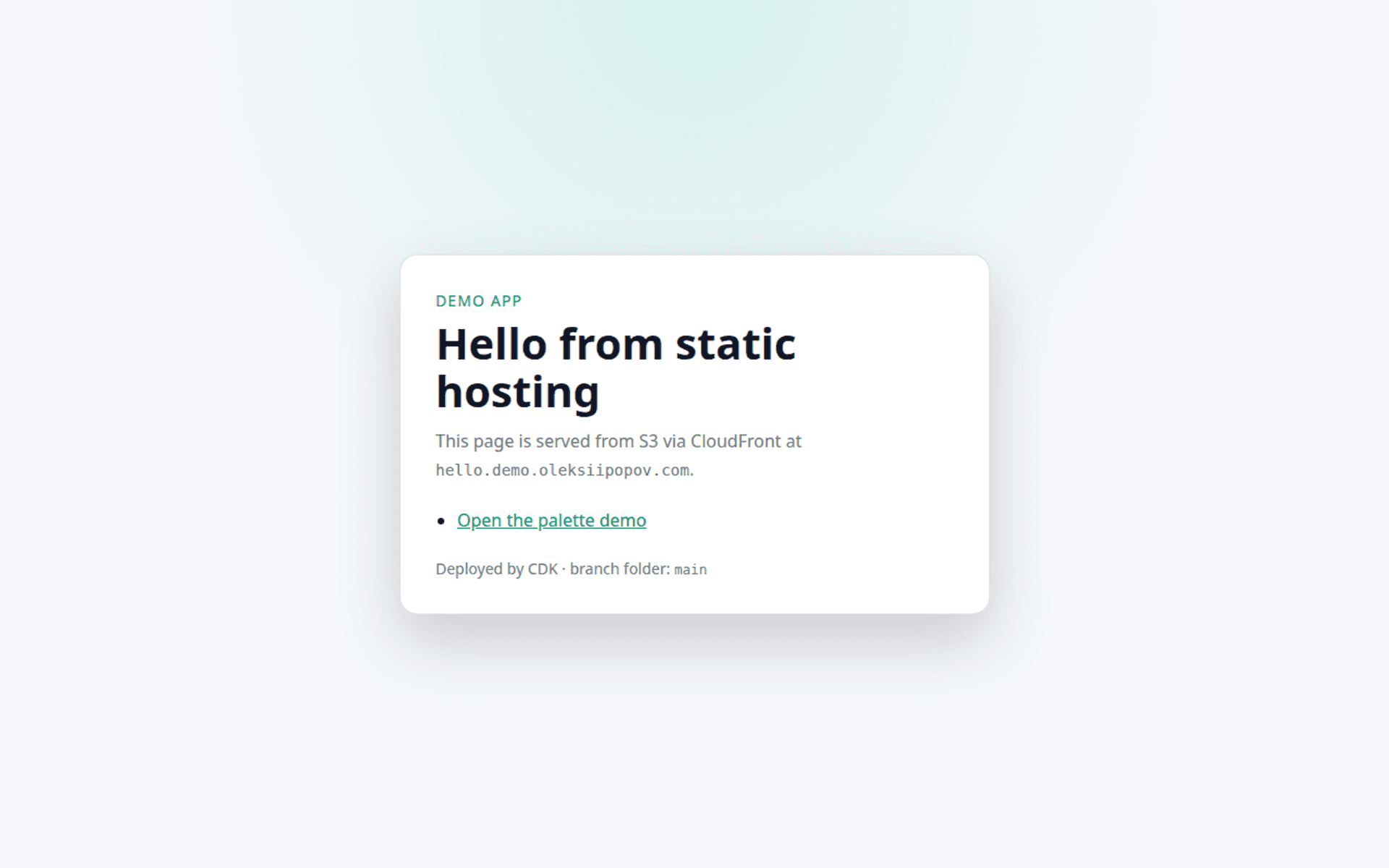

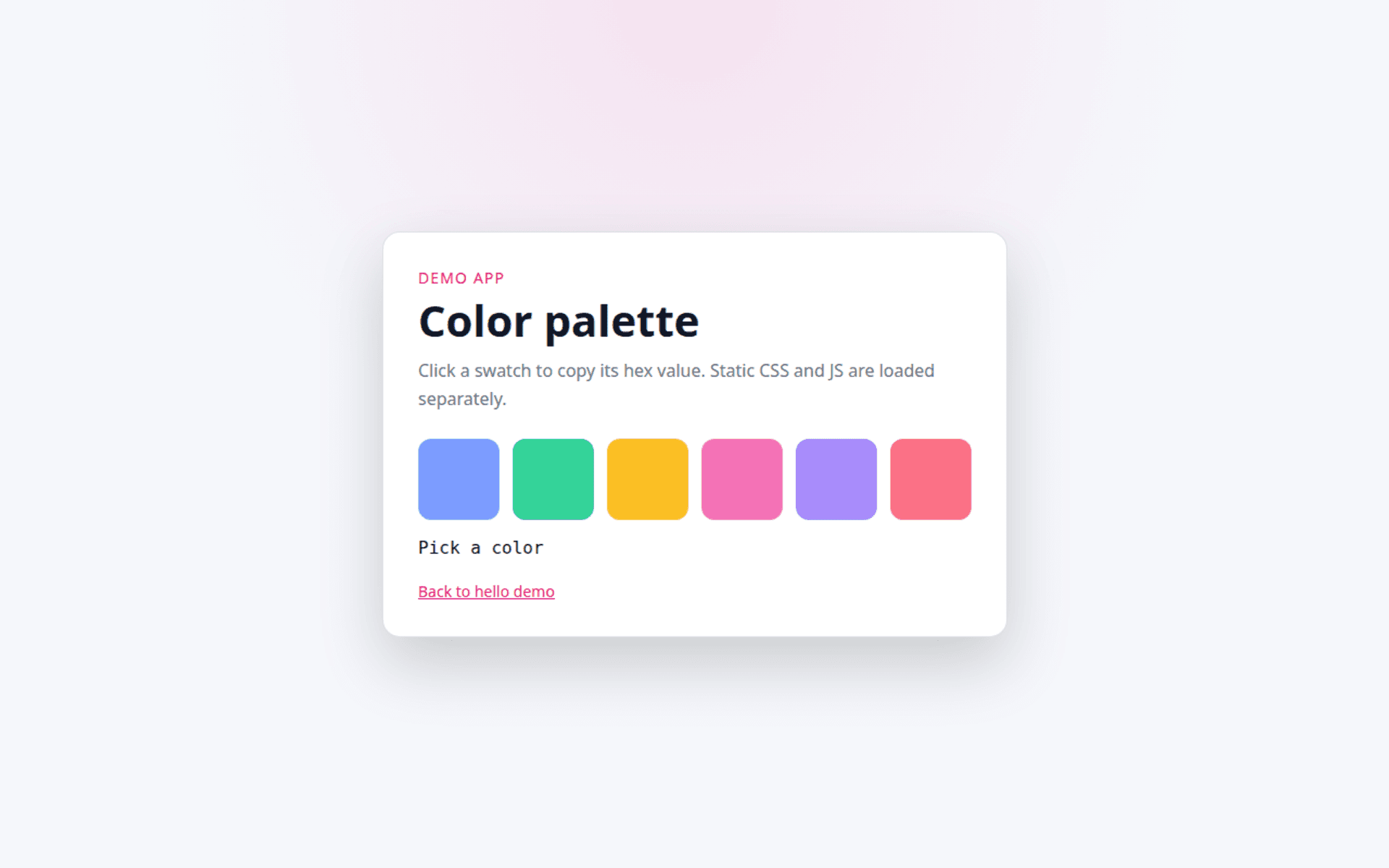
These prove routing and caching without any GitHub app repo. They are good smoke tests after infra changes.
Outside the platform (real consumer)
static-hosting-demo-app is a minimal SPA in its own repository — public/ assets, pnpm build → dist/, and the two workflow files shown above. No CDK, no AWS IDs in GitHub secrets.
On every pull request, the platform workflow builds the app, uploads to s3://…/hosting-demo/{sanitized-branch}/, and comments the preview URL on the PR. When a remote branch is deleted, cleanup.yml calls cleanup-branch.yml with the same app-slug.
Branch preview in practice (verified)
To prove the external app path end-to-end, I opened PR #2 on branch test/feature-branch-hosting:
- Added a visible yellow badge and
data-e2e="feature-branch-preview"in the app HTML (so production and preview are easy to tell apart). - Pushed the branch — GitHub Actions ran the reusable
deploy-app.ymlworkflow successfully (~22s). - The PR received an automatic comment with the preview URL.
The branch name test/feature-branch-hosting was sanitized to test-feature-branch-hosting for both the S3 prefix and the subdomain:
| Git branch | Sanitized | Preview URL |
|---|---|---|
test/feature-branch-hosting | test-feature-branch-hosting | https://hosting-demo--test-feature-branch-hosting.dev.demo.oleksiipopov.com |

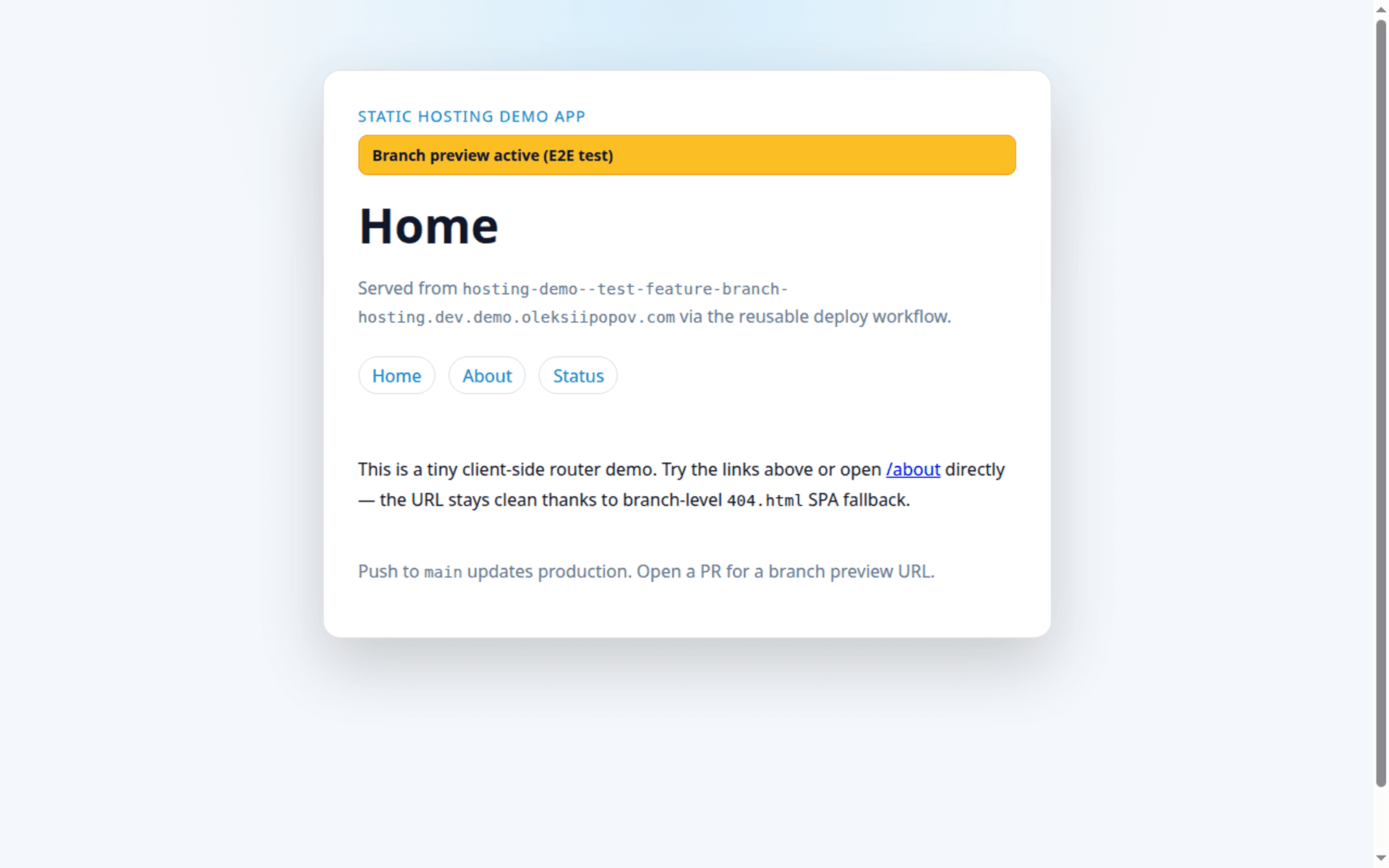
Checks that passed:
- S3 — objects under
hosting-demo/test-feature-branch-hosting/(index.html,404.html, assets). - Preview — HTTP 200, HTML contains the badge and
data-e2emarker. - Production — hosting-demo.demo.oleksiipopov.com still serves the previous build without the badge.
When the remote branch is deleted, cleanup.yml should remove the prefix and the preview hostname should return 404. The repo README has a manual checklist to repeat the full open → verify → delete branch → verify cleanup flow.
CI/CD flow
Platform repo workflows (same repository):
| Workflow | Role |
|---|---|
deploy-infra.yml | CDK deploy when infra changes |
deploy-app.yml | Reusable build + sync + invalidate + PR comment |
cleanup-branch.yml | Reusable delete prefix for one app/branch |
invalidate-app.yml | Manual cache bust |
validate-infra.yml | Typecheck, tests, synth on PRs |
Apps need pnpm, AWS_AUTH_ROLE (OIDC), and permissions: id-token: write.
S3 layout (mental model)
Each app should deploy its own 404.html at the app root (/{app}/404.html) when possible, plus per-branch copies for SPA routing.
Caching
- HTML and “extensionless” paths use a short CloudFront cache policy (~5 minutes at the edge).
- Common static extensions (
.js,.css,.png, …) use CachingOptimized behaviors. - Freshness on deploy comes from shared workflows: after
s3 sync,deploy-app.ymlinvalidates/{app}/{branch}/*and/{app}/404.html. Feature-branch previews update per push, not by waiting for TTL expiry. aws s3 syncdoes not set objectCache-Controlmetadata — and apps do not need to. Invalidation is the platform contract for cache busting.- Edge TTL policies only matter between deploys (e.g. manual S3 uploads that skip CI).
How this compares to my older hosting article
This platform is a direct descendant of Simple static web hosting AWS infrastructure with protected Dev environment (2023). Same building blocks — S3 origin, CloudFront, Route53, GitHub Actions — different tenancy and access model.
| Topic | Older simple hosting | This platform |
|---|---|---|
| Apps | One site, path-based branches on dev host (dev.example.com/{branch}/) | Many apps, subdomain per app ({app}.demo..., {app}--{branch}.dev.demo...) |
| Dev access | WAF IP allowlist on a separate dev distribution | Public preview URLs on *.dev... (shareable demo links) |
| Distributions | Two (prod + dev) | One (subdomain routing via CloudFront Function) |
| App repos | Same repo as infra; manual or monolithic CI | Separate repos + reusable workflow_call workflows |
| Browser routing | Hash/query routing only in the original scope; SPA routing listed as a future need | Closest 404.html resolver + per-branch SPA fallback |
| Best when | One product, confidential WIP, office/VPN IP ranges | Many small static demos, agents, “here’s your link” iteration |
The older design is still the right call when you need a private dev environment behind a firewall. This platform trades that for many public previews and minimal ceremony per new demo — closer to the “additional requirements” I sketched at the end of the 2023 article, without turning every experiment into its own CloudFront distribution.
Tech stack
- AWS CDK (TypeScript) — bucket, OAC, CloudFront, ACM, Route53, Lambda@Edge, SSM params
- CloudFront Function — subdomain → URI rewrite
- GitHub Actions — OIDC,
mise, reusable workflows - Node 24 + pnpm — aligned across platform and app repos
Full specification (kept in sync with code): docs/SPEC.md.
Adding your own app
- Create a static app repo with
pnpm buildoutput (e.g.dist/). - Pick an
app-slug(lowercase, hyphens, no--). - Copy
deploy.ymland optionalcleanup.ymlfrom the demo app. - Set
AWS_AUTH_ROLEand ensure OIDC trust on the shared IAM role. - Push to
mainfor production; open a PR for a preview URL.
The platform repo includes a create-demo-app skill/script to scaffold a new consumer repo.
Conclusion
The original ask was not “build a PaaS.” It was: let people (and agents) draft ideas, get a link, and iterate — without a deployment lecture.
This platform is the smallest thing that fit: one bucket, one distribution, predictable URLs, thin app repos, and branch previews that work the same way for every static app. Demo apps inside the CDK package prove routing; the external hosting-demo repo proves real consumers can plug in with a few lines of YAML.
If you are in the same situation — many small front ends, AI-assisted workflows, and a need to share progress as a URL — a shared subdomain router on CloudFront is a solid fit. Just keep the scope static, invest in sanitization and cleanup early, and accept that anything needing a backend belongs somewhere else.
Repositories: platform · external demo app
Table of Contents
Navigate through the article
Comments